


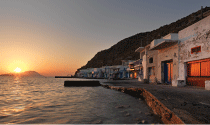

Unique Civilization
Milos is inhabited since the Neolithic period (7000-2800 B.C.).
During the Bronze Age (2800-1100 B.C.) it was a very important centre of Cycladic civilization, with Phylakopi as its focal point.
Phylakopi prospered thanks to the trade of obsidian and gave its name to an entire archaeological period.
Arts were particularly developed in ancient Milos and pottery reached perfection. The magnificent
“Melian amphorae (urns)” and the famous “Crater of Milos” (640 B.C.) are greatly admired today.
In the Hellenistic period, great works of art were produced on the island, such as the statue of Poseidon housed in the Archaeological Museum of Athens and the famous Aphrodite of Milos (Venus de Milo) that is now found in the Louvre Museum.
Theophrastus, in his work entitled “On Stones” makes a reference to the “soil of Milos”, which, mixed with colour, extended the vividness of the paintings.
Building activity on the island has been uninterrupted for 4,000 years. The new settlements, most of them built on the locations of the ancient ones, are of great architectural and folkloric significance.
Milos has remarkable museums, such as the Archaeological Museum, the Historical and Folklore Museum, the Ecclesiastical Museum and the Mining Museum.
During the Bronze Age (2800-1100 B.C.) it was a very important centre of Cycladic civilization, with Phylakopi as its focal point.
Phylakopi prospered thanks to the trade of obsidian and gave its name to an entire archaeological period.
Arts were particularly developed in ancient Milos and pottery reached perfection. The magnificent
“Melian amphorae (urns)” and the famous “Crater of Milos” (640 B.C.) are greatly admired today.
In the Hellenistic period, great works of art were produced on the island, such as the statue of Poseidon housed in the Archaeological Museum of Athens and the famous Aphrodite of Milos (Venus de Milo) that is now found in the Louvre Museum.
Theophrastus, in his work entitled “On Stones” makes a reference to the “soil of Milos”, which, mixed with colour, extended the vividness of the paintings.
Building activity on the island has been uninterrupted for 4,000 years. The new settlements, most of them built on the locations of the ancient ones, are of great architectural and folkloric significance.
Milos has remarkable museums, such as the Archaeological Museum, the Historical and Folklore Museum, the Ecclesiastical Museum and the Mining Museum.
Milos… Its shores, an enormous sculpture made up of colourful rocks...
 NETVOLUTION